Records, digital files and stories behind the versions I own.
After a long time in preparation, this collection sees the light of day, coinciding with the 56th anniversary of the original Jesus Christ Superstar album, released in the United Kingdom on October 16, 1970.
Machine translation. Interface and sheet texts are machine-translated from the Spanish original and may contain errors. titles, catalogue numbers and other catalogue data are not altered.
"Overtura"
About this collection
About this collection
This is a page in constant transformation (I don't know whether it is evolving or devolving), much like life itself. I ask you to approach it with the same generosity with which I have embarked on this project, and to forgive any inaccuracies that may exist. It is not intended to be an encyclopedia on the subject, but simply one of the many contributions available online.
In the Temple section, you can find a list of the recordings I own, which I update as I acquire more material and information. As in the work itself, the Temple is a meeting place for merchants. Material can also be exchanged here, although there will never be any financial compensation. To do so, you simply need to check that the item appeals to you and get in touch by email. Clicking on a record cover will take you to further information, based on research and personal observations. Naturally, any contribution of material or information on any aspect is greatly appreciated and will undoubtedly enrich this space.
For questions, corrections or exchange proposals, write to me through "What's the Buzz?", this collection's contact section.
About the work
Jesus Christ Superstar is undoubtedly one of the most controversial works in modern musical theatre.
The story follows the final days of Jesus, but presents them through the tensions among those around him. Judas admires his master while also fearing the direction everything is taking; this contradiction ultimately leads him to betray him. Mary Magdalene seeks to grow closer to Jesus through affection, while Pilate struggles with the decision to condemn him. The work portrays a Jesus who feels fear, suffers and doubts, and a crowd whose enthusiasm eventually turns against him. The story ends with the crucifixion: it does not include the resurrection, keeping the focus on the human conflict experienced by its characters.
The original idea was to stage the work in a theatre and turn it into a typical Broadway show, but the authors could not find a producer willing to embark on such an undertaking. As a result, their first option was to record a concept album, which would be released in 1970. And that is where it all began.
Documents of an Expansion · 1971-1972
"The Trial Before Pilate"
The album's success brought the work into circulation before many cities could see an authorized production. The songs moved into concerts, theatre, and other recordings. The lawsuits of those years show that these boundaries were not so clear-cut.
These stories explain how the work circulated. The cases identify specific companies and performances, but they do not establish the provenance of a record in this collection.
The Concert That Told the Whole Story
Sperber · New York, 1971-1972
The Original American Touring Company performed twenty of the work's twenty-three songs, interspersed with other religious pieces. Its defense relied on ASCAP licenses for non-dramatic musical performances.
The first ruling, dated August 26, 1971, did not stop these performances: it found the evidence presented insufficient to obtain an injunction. It did, however, prohibit the use of the work's title in the company's advertising.
The appeal of March 17, 1972, changed the scope of the injunction. The singers retained their characters, entered and exited, and followed almost the entire sequence of the work: 78 of its 87 minutes. In the court's view, this told the story and constituted a dramatic performance, even without scenery or costumes.
What We Know and What Is Missing. This is a ruling on an injunction and the likelihood of success at trial, not a final judgment awarding damages. The company involved in the lawsuit should not automatically be identified with National Rock Opera Company or its recording.
The Religious Defendants Who Argued It Was an "Oratorio"
Contemporary Mission · O'Reilly, 1972
Six fathers and Brother Richard Palmese, members of Contemporary Mission, are listed among the defendants. They were not seven priests. Some of them ran a professional company with lay performers.
The July 25, 1972, ruling records more than fifty performances and, for fifty of them, approximately $300,000 in gross revenue and about $220,000 net. The defense argued that it was an oratorio, not a dramatic performance, and cited its religious and charitable purpose.
The judge did not equate that touring company with a church choir. He rejected those defenses when granting the injunction: presenting the work as a religious activity did not eliminate its authors' rights.
What We Know and What Is Missing. The figures and arguments come from the ruling. The injunction does not establish a final damages award, nor does it prove that a recording in the collection originated from these performances.
Another lawsuit concerned performances announced at Philadelphia's Shubert Theatre between December 24, 1971, and January 1, 1972. The appellate ruling of June 29, 1972, describes the proliferation of unauthorized performances that accompanied the success of Superstar.
But the outcome was not a finding of infringement. The appeal was dismissed on grounds of mootness and jurisdiction; the court vacated the denial of the injunction under appeal. The show's schedule mattered as much as the dispute over its rights.
What We Know and What Is Missing. This lawsuit documents a dispute and specifically identified performances. It does not definitively resolve whether infringement occurred, nor does it allow a record to be attributed to them.
Milwaukee: Four Performances After the Court Hearing
The dispute did not begin on Broadway. Record World reported on July 3, 1971, that an attempt to stop Superstar Productions and The Original American Touring Company had been rejected following a hearing on June 7 in Milwaukee. The company subsequently gave four sold-out performances at Uihlein Hall.
The magazine quotes Judge Myron L. Gordon: the application had come too late, and the audience had been informed that it was a concert of selections. This is a report of a specific measure, not a general authorization for any production or evidence concerning a record.
Record World published the opposing positions of Stigwood and Betty Sperber on August 21. She claimed that no injunctions had been granted against her company in Washington and Wisconsin and that she had canceled Miami because of a disagreement over advertising. These are statements attributed to Sperber and her lawyer, not an independent conclusion about the entire tour.
The same page reproduces a ruling against American Rock Opera Company. That company must not be confused with The Original American Touring Company or National Rock Opera Company: sharing repertoire or similar names does not make their lawsuits one and the same.
National Rock Opera: A Note of Caution Before Linking the Names
JCS Zone states that National Rock Opera Company was able to continue after a favorable court order. That ruling has not been located among the sources cross-checked. The Lawrence Pierce case of August 1971 concerns Betty Sperber and The Original American Touring Company, not an authorization for National Rock Opera.
For this reason, the legal account is brought together here, separate from the information about the Brown County Chorale LP and the National Rock Opera double album. A judgment concerning one company does not, by itself, establish the authorization, provenance, or master recording of a recording by another.
The clipping titled "Some Protest Performance of ‘Superstar’" describes a peaceful protest by several religious ministers and approximately a dozen teenagers outside the Brushfork National Guard Armory. They did not prevent the public from attending The Original American Touring Company's performance; the report describes the venue as nearly full.
The opposition concerned the way Jesus and Judas were portrayed. This episode is part of the work's reception history, but it does not document a judgment or a cancellation. The NewspaperArchive index identifies this clipping as being from the Bluefield Daily Telegraph of November 28, 1971; its text places the performance on Saturday the 27th. It confirms that performance, not the date or provenance of a recording.
Green Bay: The Threat of a Lawsuit Before a Performance
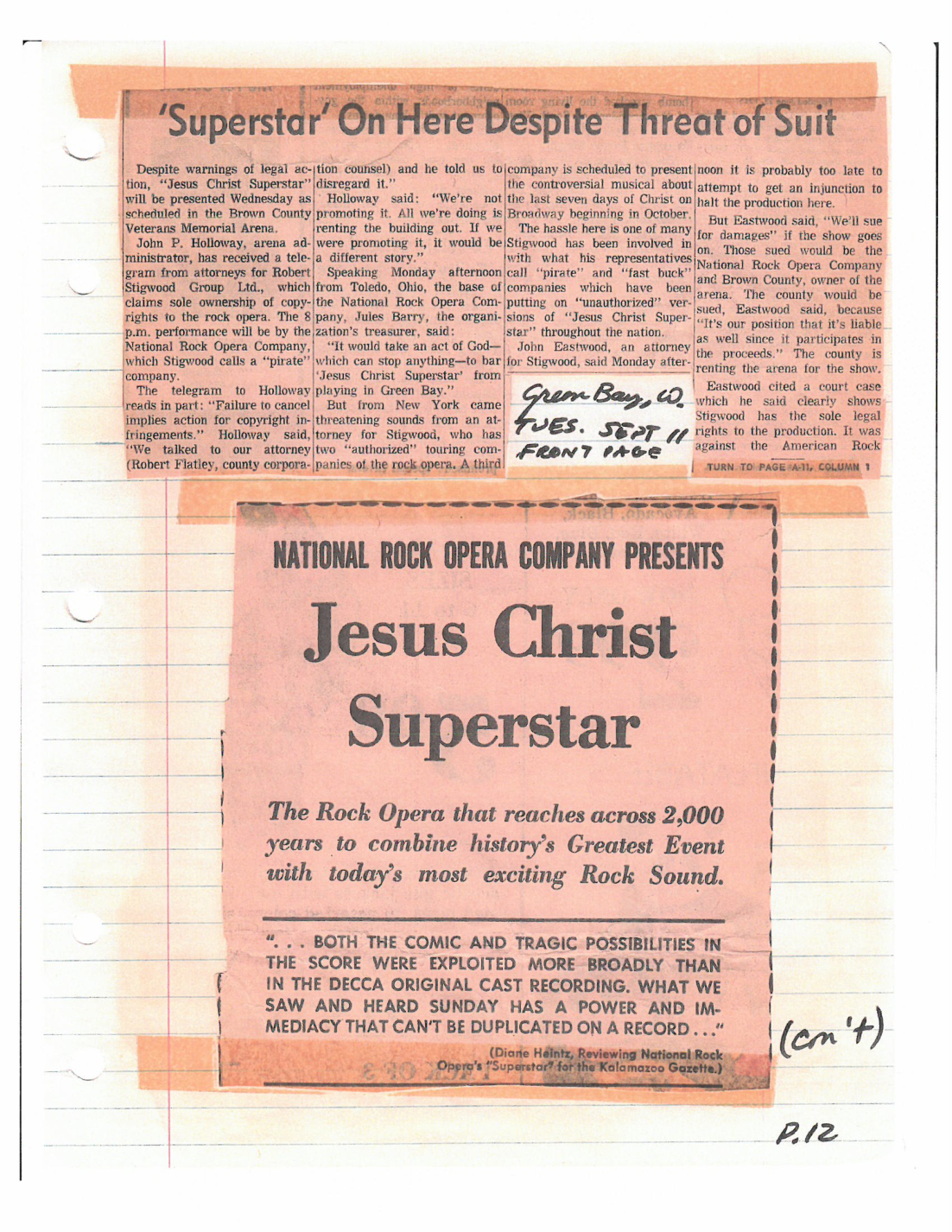
A Performance Announced Under Threat of a Lawsuit
An administrator at the Brown County Veterans Memorial Arena received a telegram warning of possible copyright infringement if he did not cancel Superstar. According to the clipping, National Rock Opera Company's performance was still scheduled for Wednesday at eight in the evening.
The administrator distinguished between renting the venue and promoting the show: he said he was only renting it out. A company representative claimed that it would take “an act of God” to prevent the performance. The opposing lawyer spoke of seeking damages if they went ahead.
Green Bay, Wisconsin, clipping kept in the folder, page 42 of the PDF; handwritten note “Tues. Sept. 14”, with no year written on this page. The newspaper's name does not appear in the clipping.
A Report of an Order Does Not Replace the Judgment
"Stigwood Gets Injunction", in Record World dated September 4, 1971, reports Stigwood's announcement of August 26 and summarizes the measure against Sperber and The Original American Touring Company as a ban on advertising and presenting the complete opera. The article explains how the decision was communicated; it does not alter its terms.
The district court ruling denied the injunction concerning performances of selections because the evidence was insufficient, but it did restrict advertising using the title. The newspaper headline should therefore not be turned into a blanket ban on all the company's concerts or a final judgment concerning a record.
The appeal, 457 F.2d 50, compares Exhibit 3, the program for an OATC concert, with Exhibit 4, the track list of the commercial album. Note 4 reproduces both lists; the program includes King Herod's Song, but no performer's name, date, city, or venue is provided. This evidence supported the discussion of the dramatic sequence of the songs, not the identification of a recording.
On September 11, 1971, Cash Box reported counterclaims totaling $40 million filed by Sperber and OATC against Stigwood and the Leeds publishing companies. The follow-up separates a $20 million libel claim from another claim for $10 million over alleged civil rights violations. These were amounts and allegations announced by the defendants, not damages awarded by a court. The report again summarizes the denial of part of the injunction and the advertising restriction; it does not grant a general license.
Sperber's appellate ruling opens with a measure of the work's success: more than two million records and tape cartridges of the complete work sold, and more than one million dollars earned by the authorized tour in its first four weeks. These figures are cited by the court, not drawn from a record-industry audit; the text does not specify the country in which those sales occurred.
On August 21, 1971, Billboard reported eighteen court actions and hundreds of performances halted by letters or phone calls, according to Stigwood. That attribution matters: this is not an independent count of all court cases.
The success also created room for studio, orchestral, choral, and budget-label recordings. Not all of them featured theatrical casts. Nor should they be called "bootlegs" because of their price, title, or resemblance to the original: permission for a performance and permission for a recording are separate matters.
What We Know and What Is Missing. The market helps explain the abundance of versions. The history of each record requires its own credits, studio, label, and date. A shared producer, musician, or similar cover does not by itself establish a common master recording.
Andrew Lloyd Webber was born in London on 22 March 1948 and grew up in a family of musicians: his father, William, was a composer and organist; his mother, Jean, was a pianist and violinist; his brother Julian would become a cellist. Music was not an isolated hobby, but part of everyday family life. However, young Andrew was also drawn to theatre and architecture: he built small stages out of toy building blocks, including one with a revolving platform. [1]
His path was not a straight line from conservatoire to stage. He began studying History at Magdalen College, Oxford, but left university to devote himself to writing. In a 1976 interview, he explained that he had largely taught himself: his father, a composition teacher, feared that too much study would stifle the spontaneity of his music. Later, he studied orchestration and argued that musical composers should make their own orchestral arrangements. [1, 2]
With Tim Rice, he would find the collaborator behind his first major successes: Joseph and the Amazing Technicolor Dreamcoat, Jesus Christ Superstar and Evita. Other paths followed, including Cats and The Phantom of the Opera. The starting point for Cats had its roots at home: when he was young, his mother had read him T. S. Eliot’s poems. Lloyd Webber told NPR that, after working with Rice, he wanted to try composing music to existing verses, rather than writing a melody first and adding lyrics afterwards. [3]
Tim Rice: the pop enthusiast who ended up writing for the theatre
Tim Rice was born in Amersham, Buckinghamshire, in 1944. Before making a living from songs, he worked as a trainee in a law firm. He was passionate about pop music and even proposed a book about its history to publisher Desmond Elliot. The book did not interest him, but Elliot saw the potential for a creative partnership: he knew a young composer who was looking for a lyricist. On 21 April 1965, Rice wrote to Lloyd Webber, and they soon met. [4]
Rice had not primarily imagined a future in theatre. In a 2023 interview, he recalled that he had started writing songs in an attempt to sell his own voice as a singer. His first released single was not a success. When he met Andrew, he found someone determined to write musicals who admired Lionel Bart and Rodgers and Hammerstein. Rice knew their songs, although he had attended few musicals. They understood each other because each admired what the other could do. [5]
While that collaboration was beginning, Rice joined EMI’s artists and repertoire department and worked with Norrie Paramor. The first musical he wrote with Lloyd Webber, The Likes of Us, was about the philanthropist Thomas John Barnardo, with a libretto by Leslie Thomas. It found no producer and did not receive its first public performance until 2005, at Lloyd Webber’s Sydmonton Festival. Joseph would give them the opportunity to see their work performed; Superstar, the international breakthrough. [4]
Rice’s fascination with Judas and Pilate dated back to his school years. He was interested in asking himself how he might have acted in their circumstances. In Superstar He turned this concern into a dramatic point of view: Judas would not simply be the villain of the story, but someone worried about the direction taken by the man he admired. This is Rice’s own explanation, not an interpretation added in retrospect. [5, 6]
After Evita, their interests began to diverge. Rice summed it up with humour: for Cats , he had been replaced by a dead poet. He continued with Chess, alongside Benny Andersson and Björn Ulvaeus, and with projects for Disney: Aladdin, with Alan Menken, and The Lion King, with Elton John. His collaboration with Lloyd Webber was not entirely over: they both wrote You Must Love Me for the film of Evita. [4, 5]
Before Superstar: what they learned from Joseph
The title is Joseph and the Amazing Technicolor Dreamcoat. Music teacher Alan Doggett commissioned a piece for the Colet Court choir. Its first performance took place there, in London, on 1 March 1968. [9] It did not begin as the full-length show known today, but as a short school production. It grew through new songs and revisions, even after the success of Jesus Christ Superstar. It is therefore important to distinguish the Joseph of 1968 from its later versions. [4, 7]
There is a documented musical connection, although it does not prove that a specific melody in Superstar comes from Joseph. In a 1976 interview, Lloyd Webber explained that with Joseph they discovered they could tell a story continuously, without stopping the music to introduce dialogue, and move freely between styles: from musical theatre to calypso, country or an imitation of Elvis Presley. Journalist Judith Weinraub explicitly linked this discovery to the subsequent development of Superstar and Evita. [2]
Rice also recalled that recording Superstar as an album helped them dispense with dialogue and work with a rock band and an orchestra. The sung-through continuity they had experimented with in Joseph thus took on a different scale and tone. [5, 6]
One interesting detail is supported by Lloyd Webber’s official website: it traces the origin of the melody of Superstar to a note scribbled on a napkin while he was developing ideas for another biblical project after Joseph. The official chronology even preserves a provisional lyric: "Samuel, Samuel, this is the first book of Samuel". The source does not present the melody as a song taken from Joseph: it was material for a new biblical idea. [8, 9]
The move to the record: do not confuse support with production
The first single from Superstar was recorded at Olympic Studios, with Murray Head and the Trinidad Singers. Lloyd Webber’s official chronology gives its British release date as 21 November 1969 and its American release date as 1 December. Mike Leander, MCA’s head of artists and repertoire, and Brian Brolly supported the project; the same source explicitly states that Rice and Lloyd Webber were able to produce the single themselves. It does not credit Norrie Paramor as producer. [9]
What connects the music, and what has not been proven
Musicological connection: rhythm
In Andrew Lloyd Webber , John Snelson describes a specific example: in "Poor, Poor Joseph", the sung phrases are in 5/4 and the instrumental interruptions are in 5/8. He then identifies a tendency in Lloyd Webber’s work to build short, repeated units contained within the bar, citing "Everything's Alright" and "The Temple", from Superstar, among his examples. This is continuity in compositional technique, not a claim that a melody was copied from one work to another. [10]
Snelson also distinguishes the pop sound of Joseph from the rock sound of Superstar. A difference does not mean there is no connection at all. He also notes that the parade of pastiches for which Joseph is now known grew as the work expanded: not all those numbers belonged to the original cantata. [10]
An early detail about "Close Every Door"
The ruling in Repp v. Webber, 947 F. Supp. 105 (1996), states that "Close Every Door" was one of the earliest parts of the choral version of Joseph, written in 1967-1968, and that its melody, harmony and rhythm did not change in the expansions considered by the court. This documents the song's early date; it does not prove borrowing into any song in Superstar. The lawsuit concerned Ray Repp's "Till You" and the counterclaim about "Close Every Door", not the relationship between Joseph and JCS. [11]
A critic's comparison, not proven influence
The review "Dreamcoat delight", published by Blue Curtains Brisbane on March 24, 2024 about a Redcliffe Musical Theatre production, says that "Potiphar" echoes "King Herod's Song" and that the accusation in "Who's the Thief?" recalls "Trial Before Pilate". This is an identified critic's impression of a modern production, not an analysis of the 1968 and 1970 scores or a statement by the composer. [12]
What remains open
No specific derivation of "Trial Before Pilate" from "Poor, Poor Joseph" has been verified, nor a statement by Lloyd Webber acknowledging that borrowing. Nor do the sources consulted here support equating "Close Every Door" or "Any Dream Will Do" with a particular ballad from JCS. The documented connection is one of musical language and techniques, not a list of recycled melodies.
[3] Renee Montagne and Ned Wharton, "Andrew Lloyd Webber's Genius Is 'Unmasked' In New Memoir", NPR, March 4, 2018. Interview with an open transcript: childhood theatre, Eliot, melody and lyrics.
https://thin.npr.org/590247806
[4] "Biography", Tim Rice's official website, no visible date. Personal background, their meeting, EMI, early works and later collaborations. Open access.
https://www.timrice.co.uk/bio
[9] “Jesus Christ Superstar”, chronology on Andrew Lloyd Webber’s official website. Accessible text: Samuel, earlier projects, Leander/Brolly, production credits, Olympic and the single’s release dates. The chronology combines an idea about Moses with the provisional lyrics about Samuel; it is not presented here as a single completed project.
https://www.andrewlloydwebber.com/show/jesus-christ-superstar
[12] “Dreamcoat delight”, Blue Curtains Brisbane, 24 March 2024. Theatre review signed on the page as bluecurtainsbris. Open access. Used only as critical opinion, not as historical evidence of influence.
https://bluecurtainsbris.wordpress.com/2024/03/24/dreamcoat-delight/