Jesus Christ Superstar · Editions / The Temple

Jesus Christ Superstar
My record and recording collection
Records, digital files and stories behind the versions I own.
After a long time in preparation, this collection sees the light of day, coinciding with the 56th anniversary of the original Jesus Christ Superstar album, released in the United Kingdom on October 16, 1970.
Machine translation. Interface and sheet texts are machine-translated from the Spanish original and may contain errors. titles, catalogue numbers and other catalogue data are not altered.
Full information: Arthur Fiedler "Superstar"

Edition details
United States · 1971 · 1 disc: Vinyl LP, Album, Stereo
Duration: 37:13 (sum of the tracks)
Credits: Robert Bockholt (reissue; Discogs transcribes Bockhelt) - Arrangements: A1; Richard Hayman - Arrangements: A2, A4, B3 and B5; Norman Green - Cover art; David Krieger - Design; Günter Hermanns - Recording engineer; Volker Martin - Recording engineer; Lee Hulko - Lacquer cutting; Thomas Mowrey - Producer
Tracks
- A1 · Jesus Christ Superstar (Overture, Everythings Alright) · 5:36
- A2 · What Have They Done To My Song, Ma · 4:10
- A3 · Proud Mary · 2:22
- A4 · Love Story Theme · 4:25
- A5 · Gentle On My Mind · 2:56
- B1 · Love Me Tonight · 3:21
- B2 · Let It Be · 4:34
- B3 · I Think I Love You · 2:46
- B4 · Mah-Na Mah-Na · 3:06
- B5 · Bridge Over Troubled Water · 3:57
Arthur Fiedler: "Superstar" enters the repertoire of the Pops
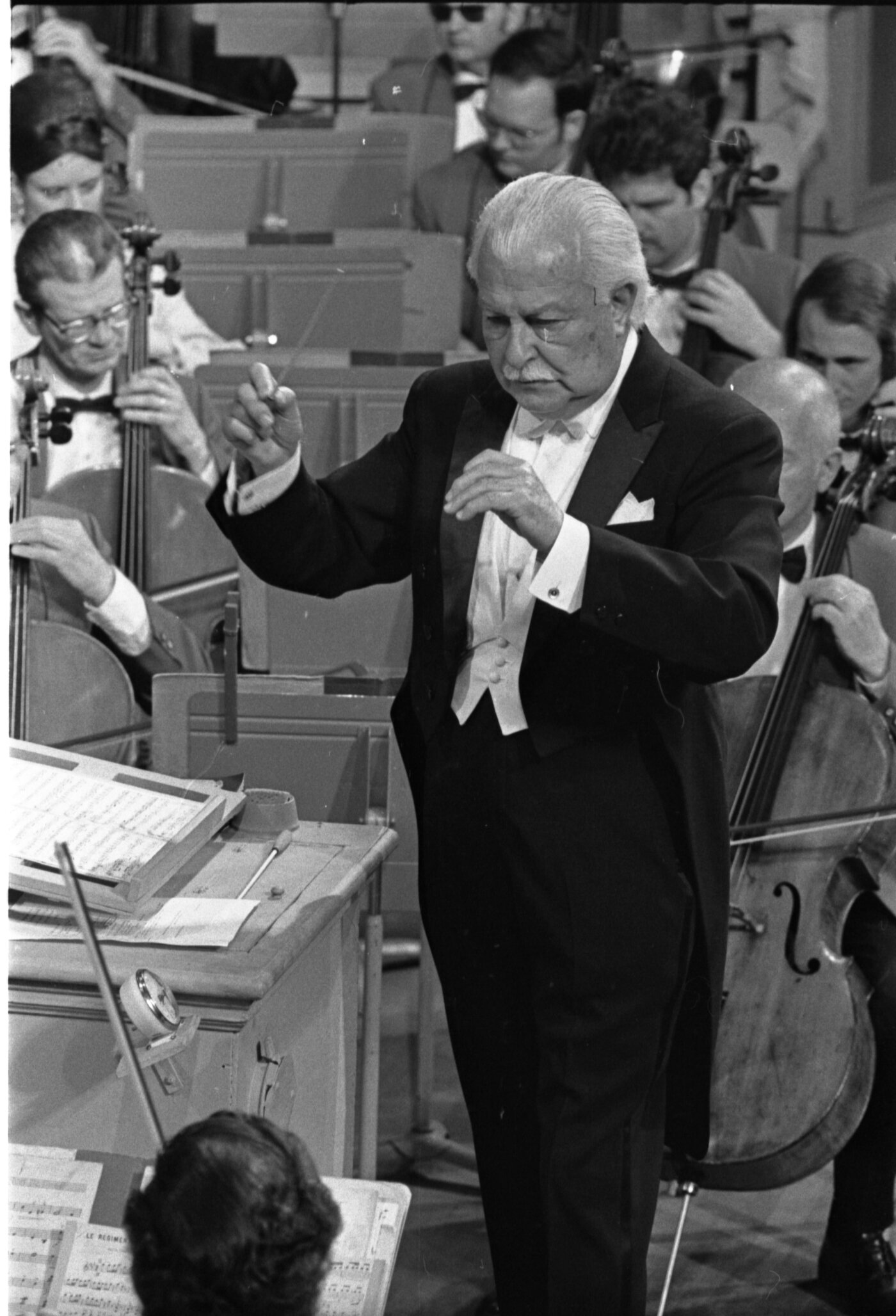
Arthur Fiedler conducting the orchestra. Photograph by Michael Peirce, courtesy of the Boston Symphony Orchestra Archives.
"Arthur Fiedler Superstar" does not try to tell the Passion nor assemble a cast of "Jesus Christ Superstar". It is an album by Arthur Fiedler and the Boston Pops Orchestra that opens with music from the opera and continues with songs by Melanie, Creedence Clearwater Revival, the Beatles and Simon & Garfunkel, among others. The title "Superstar" appears on the cover, but only the first cut belongs to Lloyd Webber and Rice's work. The remaining nine bring together popular songs and film themes. [1][2]
The difference matters: the record registers the entry of "Superstar" into another musical tradition, that of an orchestra accustomed to bringing the melodies of the moment to the public. The official history of the Boston Pops recalls that its concerts were born to combine light classics and popular music. Fiedler, who conducted the orchestra from 1930 to 1979, had turned that formula into an American institution. In 1971 he did not need to abandon that identity to play a rock opera. [3]
A single cut for an opera
The American LP PD-5008 opens with "Jesus Christ Superstar (Overture, Everything's Alright)". The entry for the Deutsche Grammophon compilation "Superstars and Songbooks - Pops by Arrangement" places that recording in August 1971, at Symphony Hall, Boston. It also dates the other nine pieces of this programme there. It is discographic information from the reissue, which allows the studio work to be placed without confusing it with a stage performance. [1][4]
The Deutsche Grammophon reissue and the credits published by Universal Music Group assign the arrangement of the first cut to Robert Bockholt. Discogs transcribes the surname as Bockhelt in its entry for the American LP. The sleeve scan consulted does not have enough resolution to settle that letter; the variant is not taken as a verified misprint. Richard Hayman signs four of the other arrangements, not all: "What Have They Done To My Song, Ma", "Love Story Theme", "I Think I Love You" and "Bridge Over Troubled Water". The credits also distinguish Marty Gold, John Woodbury, Al Woodbury, Delbert Ritti and William Goldstein. That division of tasks is part of the character of the album: several ways of bringing a popular song to a large orchestra under a single conductor. [1][4]
Thomas Mowrey produced the record, with Günter Hermanns and Volker Martin on engineering. Norman Green did the cover illustration and David Krieger the art direction. Fiedler's name occupies the centre of the edition, accompanied by an image of colours and concentric shapes that does not reproduce the religious iconography of the concept album. The presentation sells the conductor and his Pops as the stars of their own "Superstar". [1][5]
Thomas Mowrey and the Polydor period
"Superstar" formed part of a longer collaboration. In a 2013 lecture, Thomas Mowrey recalled his participation in the negotiations that ended in a five-year contract for fifty records with the Boston Symphony and the Boston Pops. He also spoke of the series of twenty-five LPs that he produced with Fiedler. It is the producer's recollection of that period, not an explanation of how "Superstar" was chosen or recorded. [14]
What the sleeve promised
Paul Kresh wrote the notes on the back. His argument was that the orchestra remained up to date: he presented Fiedler as someone capable of bringing Lloyd Webber's score, "Proud Mary" and "Let It Be" into the same programme. Speaking of "Superstar", Kresh acknowledged that its language might seem foreign to older audiences and defended the arrangement as a way of keeping its rhythmic drive. It was an invitation to hear that music within the world of the Pops, without asking the listener to adopt the whole aesthetic of a rock opera. [1]
The notes even evoked the scene of "Everything's Alright", with Mary Magdalene comforting Jesus. The commentary did not turn the orchestra into a vocal cast: it used the dramatic situation to guide the listening of the melody. Then it changed register and pointed out how pop songs could converse with an older orchestral repertoire. Kresh did not present the LP as a document of Broadway, but as a demonstration of the craft of Fiedler and his musicians. [1]
Topicality as a commercial argument
The release was being prepared for autumn 1971. Cash Box of 30 October included "Superstar" among the six new Polydor LPs and presented Fiedler's proposal as a combination of the rock opera with songs like "Proud Mary" and "Let It Be". It was not a complete edition of "Jesus Christ Superstar": the popular repertoire was part of the commercial argument from the announcement. [10]
Billboard published a favourable review on 20 November. It contrasted the fast arrangements of "Proud Mary" and "I Think I Love You" with the slower treatments of "Let It Be" and "Bridge Over Troubled Water", and praised the performance and the production. Record World, on 4 December, also reviewed it and called the selection from "Jesus Christ Superstar" a "medley". It was the magazine's description, not a subtitle that therefore appears on the sleeve. [11][12]
The promotion also found a place in the Christmas campaign. On 27 November, Billboard included the record among the products being pushed for Christmas shopping and said it was being "promoted heavily". Although it contained no carols, it could be sold as a seasonal gift. [13]
On 29 January 1972, the Canadian magazine RPM published a review of "Superstar" with the reference Polydor 2391 012-Q. The assessment insisted that Fiedler was not being left behind: it highlighted "Jesus Christ Superstar" as the opening and cited "What Have They Done To My Song, Ma" and "Let It Be" as proof of his connection with pop. The review expected a good commercial response. That expectation was not a sales figure, although the album does appear on the LP chart in that same issue of RPM: it was at number 72, after 76 the previous week. On 5 February it is at 71. These are positions observed in those issues, not a figure of copies sold. [6][15]
In the United States, "Superstar" had entered Billboard's Top LP's chart on 4 December 1971, at number 178. Its best position was 174, on 18 December. The sequence consulted documents five consecutive weeks, up to 1 January 1972; it no longer appears on 8 January. The reference PD-5008 distinguishes this record from the original album of "Jesus Christ Superstar" and from other versions circulating at the time. [7]
Thus, the title of the opera fulfils two functions on this record. It provides the opening music and announces that an orchestra with a long history can enter the present. The selection ends with "Bridge Over Troubled Water", not with the crucifixion. That ending reminds us what kind of album we are listening to: a collection of popular songs in orchestral arrangements, in which "Superstar" found a place without becoming the complete work. [1][2]
Sources
- [1] American sleeve Polydor PD-5008: repertoire, arrangers, production, engineering and notes by Paul Kresh. Record of the edition; reproduction of the back consulted.
- [2] Grand Orchestras: programme of the LP PD-5008.
- [3] Boston Symphony Orchestra: official history of the Boston Pops.
- [4] Presto Music: Deutsche Grammophon 4776127, dates, place and arrangers by work.
- [5] Florian Hardwig, Fonts In Use: art by Norman Green and David Krieger, 17 February 2024.
- [6] RPM, 29 January 1972: review of "Arthur Fiedler Superstar", Polydor 2391 012-Q.
- [7] Billboard Top LP's: 4 December 1971 - 8 January 1972.
- [8] Universal Music Group: credits of Robert Bockholt.
- [9] Deutsche Grammophon: compilation 4776127.
- [10] Cash Box, 30 October 1971, p. 35: Polydor release.
- [11] Billboard, 20 November 1971, p. 76: review.
- [12] Record World, 4 December 1971, p. 14: review.
- [13] Billboard, 27 November 1971, p. 70: Christmas promotion.
- [14] Thomas Mowrey: 2013 lecture, pp. 22-24.
- [15] RPM, 5 February 1972: LP chart.