Jesus Christ Superstar · Editions / The Temple

Jesus Christ Superstar
My record and recording collection
Records, digital files and stories behind the versions I own.
After a long time in preparation, this collection sees the light of day, coinciding with the 56th anniversary of the original Jesus Christ Superstar album, released in the United Kingdom on October 16, 1970.
Machine translation. Interface and sheet texts are machine-translated from the Spanish original and may contain errors. titles, catalogue numbers and other catalogue data are not altered.
Full information: Jesucristo Superstar - Nueva Versión Original En Español

Edition details
Spain · 1984 · 1 disc: Vinyl LP, Album
Duration: 45:26 (sum of the tracks)
Credits: Teddy Bautista - Arrangements, Direction, Producer; Jaime Azpilicueta - Direction; P. J. McNamee - Sound engineer (printed credit); Robert W. Baldwin - Executive producer; Tim Rice - Lyrics; Andrew Lloyd Webber - Music; Peter McNamee - Sound design (printed credit); Estíbaliz Uranga - Vocals; Jaume Baucis - Vocals; Pablo Abraira - Vocals; Pedro Ruy-Blas - Vocals; Sergio Blanco - Vocals; Tony Cruz - Vocals
Tracks
- A1 · Obertura · 3:55
- A2 · Canción De Judas · 4:28
- A3 · Nada Va A Pasar · 3:42
- A4 · Jesús Morirá · 3:52
- A5 · Hosanna · 2:54
- A6 · Simón Zelaotes · 3:05
- B1 · Es Más Que Amor · 3:28
- B2 · Getsemaní · 5:30
- B3 · Canción De Herodes · 3:01
- B4 · Todo Ha Sido Un Sueño · 2:48
- B5 · Juicio de Pilatos · 5:47
- B6 · Superstar · 2:56
It is the new Spanish version of 1984, with the cast of the Teatro Alcalá Palace in Madrid, on CBS (S 26191). Discogs says it was recorded at the Kirios Studios in Madrid. Teddy Bautista does the arrangements, direction and production; Jaime Azpilicueta directs; the engineer is Peter McNamee.
According to El País, the premiere of this new version was postponed from 8 September and held on 12 September 1984.
Revival context (pending confirmation): El País's contemporary report of 12 September 1984 presents an update of the music and dance, with stage direction by Jaime Azpilicueta and musical direction by Teddy Bautista. It describes a two-hour show with 34 dancers and musicians, led by Pablo Abraira, Estíbaliz and Pedro Ruy Blas. The opening was delayed because the wireless microphones did not fit Spanish batteries. The report quotes an announced budget of 80 million pesetas and a planned Latin American tour; it does not prove that the tour took place.
Disco frente a función teatral: el registro CBS enumera doce selecciones, con Obertura al inicio y Superstar al cierre, no dos horas de música ni la obra completa. Acredita a Robert W. Baldwin como productor ejecutivo y a Peter McNamee tanto ingeniería como diseño de sonido; fabricación por Discos CBS, S.A., Madrid y ℗/©1984. Los nombres vocales adicionales son Jaume Baucis, Sergio Blanco y Tony Cruz junto a Abraira, Estíbaliz y Ruy Blas; el registro no asigna papeles a cada uno, por lo que no se inventan. El disco y la duración escénica de la noticia son medidas diferentes.
Curiosity
According to El País, the premiere of this new version was postponed from 8 to 12 September 1984.
The LP Jesucristo Superstar. Nueva Versión Original en Español brings together the cast headed by Pablo Abraira, Pedro Ruy-Blas and Estíbaliz at the Teatro Alcalá Palace. It is a selection of twelve numbers, released by CBS in 1984, not a reissue of Camilo Sesto's album nor the complete record of a performance. The Spanish edition in the collection carries the reference S 26191. [1][2]
The production and the postponed premiere
Jaime Azpilicueta again directed the staging and Teddy Bautista the music, as in 1975. El País presented the production as a version with renewed music and dance. According to the production, the budget was eighty million pesetas and thirty-four dancers and musicians took part. Six months in Madrid were announced before a Latin American tour. [3]
The premiere was scheduled for September 8, but it was delayed by an unusual problem: the batteries available in Spain did not fit the wireless microphones. El País announced the official premiere for the night of the 12th. [3]
Francisco Umbral attended the premiere with Abraira. In his column of September 16 he placed the visit under the heading of the 12th and called the show "very dignified in itself", although he questioned the conversion of Christ into a cultural product. The EFE photo record carries a different date: September 11. [4][5]
Eduardo Haro Tecglen praised the production as a whole in his review of September 14. He called Abraira "the undisputed protagonist", described Ruy-Blas's Judas as "hard and anguished" and highlighted the music hall air of Baucis's Herod. He also found the sound more restrained than in 1975. Both the review and the CDAEM catalogue place the premiere at the Alcalá Palace on September 12. [12, 13]
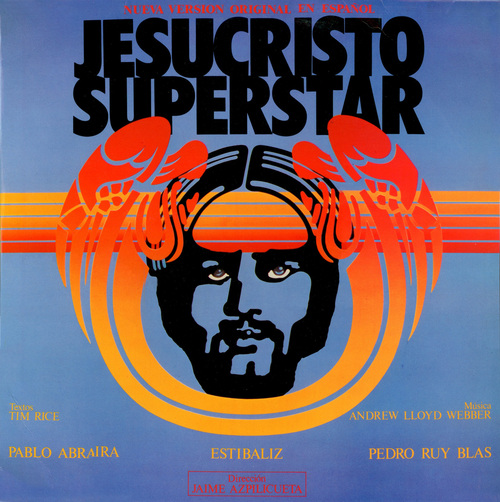
Cover of the 1984 Spanish LP. Photo from my collection, restored to reduce reflections.
Cast and musical work
The company had Pablo Abraira as Jesus; Pedro Ruy-Blas as Judas; Estíbaliz Uranga as Mary Magdalene; Sergio Blanco as Peter; Tony Cruz as Pilate; José María Amerise as Caiaphas; Javier Ulacia as Annas; José A. Morales as Simon Zealotes and Jaume Baucis as Herod. The translation was by Nacho Artime and Jaime Azpilicueta; the choreography by Goyo Montero. [6]
The back cover prints "José A. Morales" for Simon. Haro Tecglen's review and the CDAEM catalogue write José Ángel Morales; Cartelera Musicales and CastAlbums, José Antonio. The entry keeps the initial in view of this difference. [1, 6, 10, 12, 13]
Estíbaliz appears as "Estíbaliz Gabilondo" in CastAlbums, but the production documentation and the duo's discography identify her as Estíbaliz Uranga. [2][6][10]
The back cover credits Teddy Bautista with the arrangements, musical direction and production; Jaime Azpilicueta with the direction; Robert W. Baldwin with the executive production; Peter McNamee with the sound design, and P. J. McNamee with the engineering. The record was made at Estudios Kirios in Madrid. José Ramón de Aguirre did the sets and costumes, Clarke W. Thornton the lighting design and Goyo Montero the choreography. [1]
Larry Martin recalled in an interview of April 2005 that he was called to play in the musical with Bautista. Everything was written out: he had to practise sight-reading and leave room for the singers, far from the improvisation and solos of his previous bands. His testimony speaks of the work in the theatre; it does not confirm that he played on the LP. [7]
Two leads who did not arrive in the same way
Abraira explained in an interview in Spend In, preserved on his own website, that after "Lovy" and "Evita" the musicals allowed him to halt a recording career that he had felt was too accelerated. On Jesucristo Superstar, he recalled long conversations with his friend Pedro Ruy-Blas about the relationship between Jesus and Judas. The interest lay not only in working on the songs: they discussed how to build the characters together. [8]
Ruy-Blas left a less complacent impression in an interview published in February 1985 and recovered by José de Segovia in 2014. He had not seen the earlier Madrid production. The job offered him a dramatic role he had wanted for years and a certain financial stability. He valued the stage professionalism, but was critical of the work; of the film he knew, he was especially interested in the music and the Judas with rhythm and blues and gospel roots. [9]
For Abraira, the musical allowed him to stop and think about the characters; for Ruy-Blas, it was a dramatic and financial opportunity, although he had reservations about the work.
The LP: repertoire and scope
Each side contains six tracks and brings together central moments of the work. [1][10]
Side A
- "Obertura"
- "Canción de Judas"
- "Nada va a pasar"
- "Jesús morirá"
- "Hosanna"
- "Simón Zelaotes"
Side B
- "Es más que amor"
- "Getsemaní"
- "Canción de Herodes"
- "Todo ha sido un sueño"
- "Juicio de Pilatos"
- "Superstar"
The back cover writes "Simón Zelaotes". The selection ends with "Superstar", without the conclusion of the opera. [1]
Ibervinilo also documents a white-label promotional single, CBS A-4829, taken from the album: "Superstar", sung by Ruy-Blas, and "Canción de Herodes", by Baucis. [2]
Note from the collection
Pablo Abraira did not have a copy of this edition. I showed him mine to have it signed and, on seeing that he had none, bought another second-hand copy to give to the performer himself. It was 2022, 38 years after the record was released.First-hand testimony: the copy is mine.
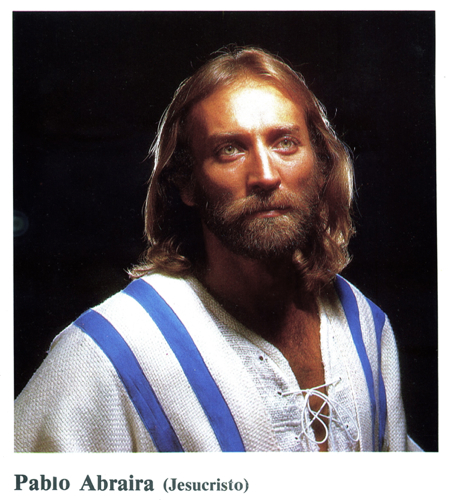
Pablo Abraira as Jesus. Cast photograph from the 1984 Madrid production.
Author not identified.
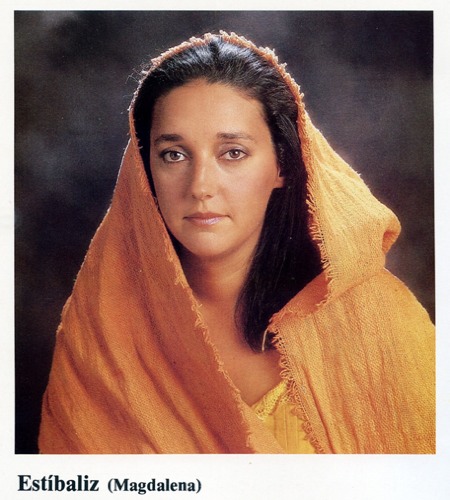
Estíbaliz Uranga as Magdalene. Cast photograph from the 1984 Madrid production.
Author not identified.
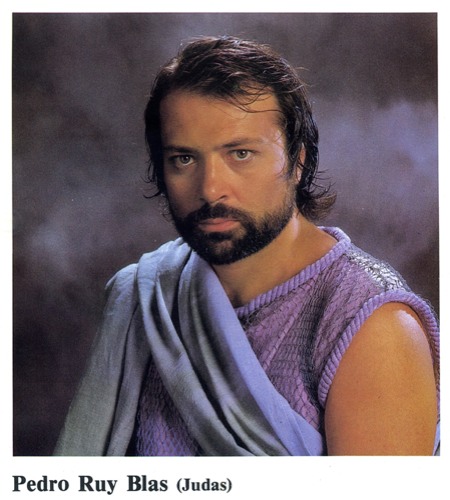
Pedro Ruy Blas as Judas. Cast photograph from the 1984 Madrid production.
Author not identified.
If you hold the rights to any of these images and want it removed, write to us.
What remains to be documented
Session documents that would specify the recording days and the musicians on the LP are missing. The EFE photograph is linked as a source, but is not reproduced for lack of a licence.
Sources
- El País, 12-9-1984: La nueva versión de 'Jesucristo Superstar' se estrena hoy en Madrid · El País, sin firma individual (12/9/1984): La nueva versión de Jesucristo Superstar se estrena hoy en Madrid · El País, "La nueva versión de 'Jesucristo Superstar' se estrena hoy en Madrid", 12 September 1984. https://elpais.com/diario/1984/09/12/cultura/463788011_850215.html · Source: El País, 12-9-1984: La nueva versión de 'Jesucristo Superstar' se estrena hoy en Madrid
- Jesus Christ Superstar Zone: Spanish Revival Cast 1984 (data cross-check only; text not reused)
- Carteleras musicales: Jesucristo Superstar 1984 · Cartelera Musicales, 1984 Madrid production: cast and team. https://www.carteleramusicales.es/jesucristo-superstar-1984
- Discogs: CBS S 26191 (View on Discogs button link) · Discogs, Spanish edition CBS S 26191: entry and photograph of the back cover examined, repertoire, credits and Kirios Studios. https://www.discogs.com/release/9255434
- Ibervinilo, discography of Pablo Abraira: LP and promotional single CBS A-4829, with photographs of the formats. https://ibervinilo.es/artistas/pablo-abraira/
- Francisco Umbral, "La elipse", El País, 16 September 1984: attendance at the premiere in the entry for the 12th. https://elpais.com/diario/1984/09/16/ultima/464133601_850215.html
- EFE, photo caption 8001786441, dated 11 September 1984. The description is consulted, the photograph is not reproduced. https://efs.efeservicios.com/foto/estreno-jesucristo-superstar/8001786441
- José Manuel Íñesta, interview with Larry Martin, April 2005, "La Caja de Música", Universidad de Alicante. https://www.dlsi.ua.es/~inesta/LCDM/Entrevistas/larrymartin_abr05.html
- José Luis Galar, interview with Pablo Abraira, Spend In, copy preserved by the performer. https://pabloabraira.com/wp-content/uploads/2013/06/Entrevista-a-Pablo-Abraira.pdf
- José de Segovia, "Una tarde con Pedro Ruy-Blas", 15 March 2014: recovery of the February 1985 interview. https://www.entrelineas.org/revista/pedro-ruy-blas
- CastAlbums, Madrid Cast 1984: format, running time and repertoire; its identification of Estíbaliz requires the correction indicated above. https://castalbums.org/recordings/jesucristo-superstar-1984-madrid-cast/2179
- Note and photographs from the collection: first-hand testimony already incorporated into this entry; signature of 2022. They are not sources for the 1984 recording session.
- Eduardo Haro Tecglen, "Más acá de la nostalgia", El País, 14 September 1984, contemporary review and premiere entry: https://elpais.com/diario/1984/09/14/cultura/463960803_850215.html
- CDAEM/INAEM, catalogue of Jesucristo Superstar, 1984 premiere: https://www.teatro.es/profesionales/tony-cruz-12348/estrenos/jesucristo-superstar-14783
- Pedro Ruy-Blas, history on his official website, recollection of the role of Judas in 1984: https://www.pedroruy-blasoficialweb.com/historia