Jesus Christ Superstar · Editions / The Temple

Jesus Christ Superstar
My record and recording collection
Records, digital files and stories behind the versions I own.
After a long time in preparation, this collection sees the light of day, coinciding with the 56th anniversary of the original Jesus Christ Superstar album, released in the United Kingdom on October 16, 1970.
Machine translation. Interface and sheet texts are machine-translated from the Spanish original and may contain errors. titles, catalogue numbers and other catalogue data are not altered.
"The Temple"
My Jesus Christ Superstar collection, organized by recording. Each card shows the formats I own. Physical editions retain their details; digital files are not assigned to a particular pressing.

First All American Cast
1971
In my collection
mp3 (131 Kbps)
Full information
First All American Cast
Jesus Christ Superstar: eight songs and a new format
English-language studio recording. United States. It is usually catalogued as 1971, although we do not know the exact recording or release date. The sleeve speaks of 1971 novelties; in March 1972 the press was already announcing the commercial album.
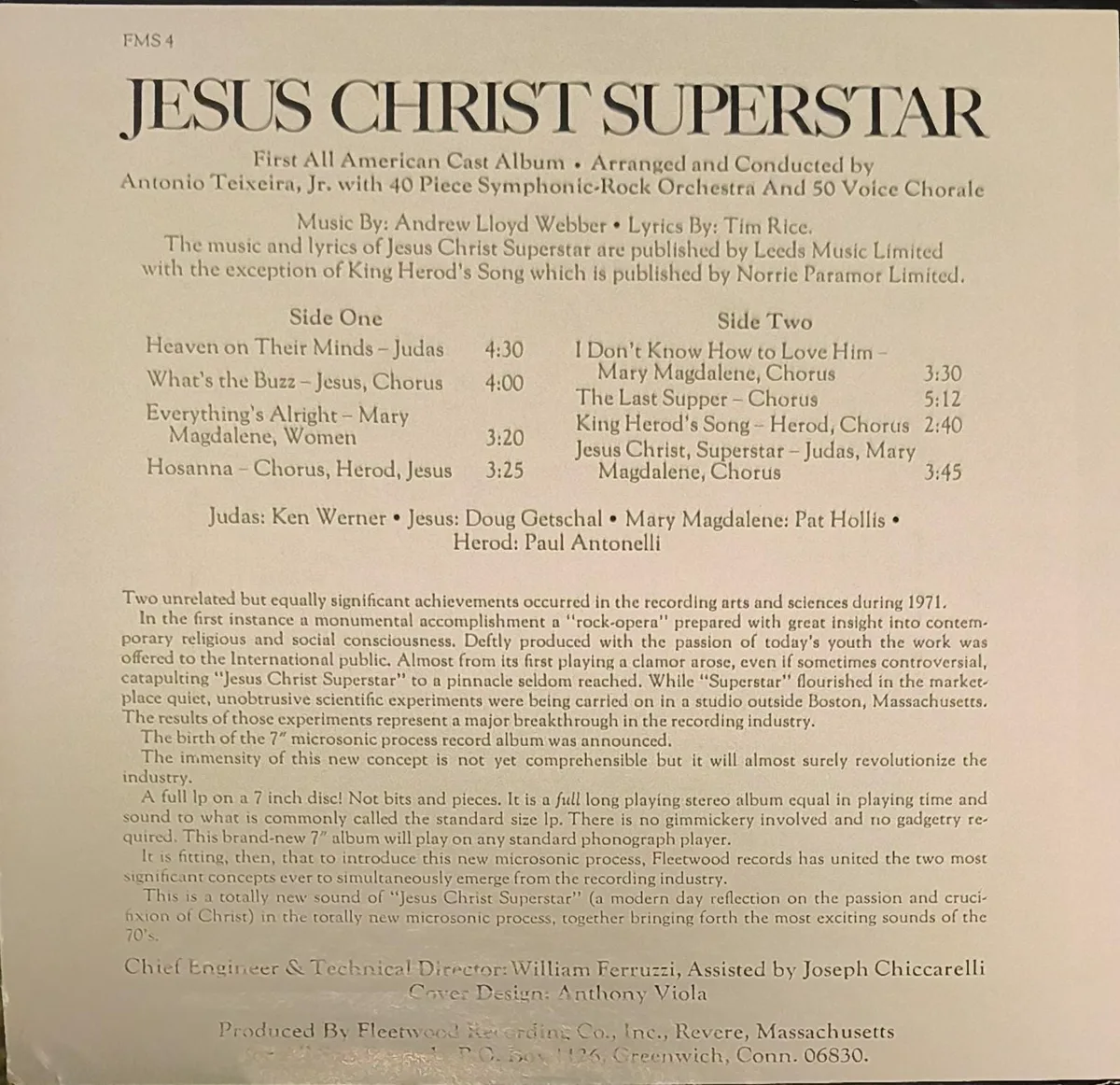
In this collection: a physical copy of the Fleetwood FMS 4 (seven-inch stereo record, Microsonic) and MP3 files. We do not know which of the two documented editions these files come from.
Documented editions: CastAlbums lists two editions: Fleetwood FMS 4, a seven-inch (17.78 cm) stereo record using the Microsonic system, and Fleetwood FCLP 7001, a twelve-inch (30.48 cm) LP. The FMS 4 sleeve is documented from the collection's copy. Its details cannot identify the LP or the MP3s on their own.
Cast and production
- Jesus: Doug Getschal.
- Judas: Ken Werner.
- Mary Magdalene: Pat Hollis.
- Herod: Paul Antonelli.
- Arrangements and direction: Antonio Teixeira Jr., with a symphonic-rock orchestra of 40 musicians and a chorus of 50 voices, according to the sleeve.
- Chief engineer and technical director: William Ferruzzi. Assistant: Joseph Chiccarelli.
- Cover design: Anthony Viola.
- Production: Fleetwood Recording Co., Inc., Revere, Massachusetts, for All-Star Records, P.O. Box 1126, Greenwich, Connecticut 06830.
- Music: Andrew Lloyd Webber. Lyrics: Tim Rice.
- Publishers indicated on the sleeve: Leeds Music Limited, except "King Herod's Song", by Norrie Paramor Limited.
Eight numbers from Superstar
The FMS 4 back cover allows these titles, characters and durations to be read:
Side one
- "Heaven on Their Minds" - Judas - 4:30.
- "What's the Buzz" - Jesus and chorus - 4:00.
- "Everything's Alright" - Mary Magdalene and women - 3:20.
- "Hosanna" - chorus, Herod and Jesus - 3:25.
Side two
- "I Don't Know How to Love Him" - Mary Magdalene and chorus - 3:30.
- "The Last Supper" - chorus - 5:12.
- "King Herod's Song" - Herod and chorus - 2:40.
- "Jesus Christ, Superstar" - Judas, Mary Magdalene and chorus - 3:45.
The printed durations add up to 30:22. This is what the sleeve announces, not a measurement of the MP3s. The characters are also reproduced, including the mention of Herod in "Hosanna". The front cover advertises "eight complete musical excerpts". It is a selection from the work, not the whole musical.
Superstar as a showcase for Microsonic
This version was presented with two arguments at once: another interpretation of a work that was a huge success and a small disc that promised to behave like a big album. The FMS 4 cover announces "stereo LP plays over 30 minutes". The back cover insists: "A full lp on a 7 inch disc! Not bits and pieces." It is not offering the whole Superstar score, but an eight-song album on a single-sized format.
The advertising speaks of two novelties of 1971: the success of Jesus Christ Superstar and the experiments of a studio on the outskirts of Boston. Fleetwood said it had combined them in Microsonic. So a fashionable work was used to introduce a new record format.
The sleeve says it was produced for All-Star Records. It does not say who chose the songs, commissioned the recording or paid for it.
Fleetwood records; All-Star distributes
High Fidelity called this Boston recording of Superstar the first commercial release of the new Fleetwood discs. In July 1972 it named All-Star Records as the distributor. Its Greenwich address is on the back cover of the FMS 4.
Billboard mentioned another company with a similar name on March 25, 1972: All Star Dairies, an association of about two hundred independent dairy companies that helped place record displays in supermarkets. It was not All-Star Records, the distributor.
On the sleeve, William Ferruzzi is chief engineer and technical director; Joseph Chiccarelli is his assistant. The JCS Zone transcription swaps them. Billboard also credits Ferruzzi with developing Microsonic.
The industrial promise of March 1972
Microsonic aimed to make a small record last as long as an LP. According to Fleetwood, it could give eighteen minutes per side on seven inches, with normal centre labels. Billboard reported that William Ferruzzi had developed a computer-controlled cutting system. The explanation came from the company.
Vincent Giarusso, co-owner with Raymond Samora, said that preparing the master disc cost 25 percent more than usual. After that, copies could be made in normal plants and played on ordinary equipment. Billboard names Capitol and RCA as manufacturers of Microsonic records, but does not say where each copy of the FMS 4 was made.
The continuation, on page 12, identifies the first finished album: eight complete songs from Superstar performed by Boston musicians. The planned supermarket racks would sell seven-inch discs at 1.49 dollars. Fleetwood was also working on other repertoires and promotional discs. Giarusso did not expect his format to replace the twelve-inch LP soon through normal distribution channels.
Three magazines put the promise to the test
Audio, June: the first report
In "Microsonic Grooves", within "Editor's Review", Audio speaks of a Revere company that had reached a density of 800 grooves per inch. The editor, signed G.W.T., mentions a recording of Superstar and says that the first seven-inch disc turned at 45 rpm and lasted more than thirty minutes per side. He considers its quality comparable to that of a conventional disc and detects no tracking problems with the cartridge he used.
This Audio report appeared before the September review. It gives no catalogue number, so it cannot identify FMS 4 or prove there was another edition.
Stereo Review, July: the bass is the limit
The answer to "A Long, Long-Play Disc", on page 24, was less enthusiastic. The reviewer received a Superstar sample from Fleetwood and found it lacked bass. Even an equalizer could not fix it. Apart from that problem, he thought the record sounded acceptable.
The press kit cited a U.S. Testing Co. survey of one thousand households: it said the record had a quality comparable to an LP and an "A" fidelity. This was Fleetwood's promotion. The reviewer did not know whether the people surveyed had received the same record he had.
High Fidelity, July: enough to demonstrate the format
"The Big Little Record", on page 28, puts the length of Superstar at a little over fifteen minutes per side. It says that, heard on equipment with wide response, the recording is not especially notable for its sound, but does show that the small disc should not be confused with children's seven-inch 33 rpm discs.
The magazine says the first samples were made on normal production lines without drawing attention. What was new was the cutting of the master disc. Fleetwood did not need a separate network of factories to make the copies; we do not know how much that saved it.
Audio, September: the FMS 4 identified
The September review is more precise in its identification: "First All American Cast Album, Fleetwood FMS 4", a seven-inch stereo disc, available in some supermarkets. It speaks of eight complete numbers, four per side, and considers the result a technical feat. The sound seems to him reasonably good, somewhat muted and at a lower level, but less loud and harsh than many 45 rpm singles. He stresses that the inner grooves are not spoiled, something especially important on such a small disc.
The "Performance: A- / Sound: B" rating just above on the page belongs to a Straube recording, not to FMS 4.
The magazines disagree about the sound. The format worked, but some tests found problems with bass or a dull sound. There are no sales figures, and no evidence that these faults caused a commercial failure.
A company used to sports records
Fleetwood was already making sports and promotional records, according to Billboard in 1972. The collectors' catalogue 45cat dates "Rock Hits of '71" (FMS 9), "ABC's Wide World of Sports", with Jim McKay (FMS 10), and "25 Action Years", with Chris Schenkel (FMS 11), to 1971. It does not give their print runs.
Keyman Collectibles documents two later uses of the format. The 1973 Topps promotion offered, in the wrapper of cards with a pitcher, the ABC disc by mail in exchange for 75 cents. It was the seven-inch FMS 10; the site distinguishes that promotion from the LP FCLP 3051, which it dates to 1970. The catalogue year and that of the offer need not coincide.
Keyman Collectibles says that on September 30, 1973 the 32,238 people at the last game of the season at Yankee Stadium received "The Sounds of a Half Century", narrated by Mel Allen, on a seven-inch record. According to the site, other fans asked for it afterwards and Fleetwood ended up offering it on a twelve-inch LP. It also describes an Eva-Tone flexi in the 1974 Yankee yearbook. The 32,238 are the attendees who, according to this source, received the giveaway, not a confirmed figure for records manufactured.
From seven to twelve inches
Billboard of 8 December 1973 shows that Fleetwood was still developing the process. In a report on its sports video work, the continuation on page 39 devotes a passage to Microsonic audio: a twelve-inch disc could hold 45 minutes per side. The first version of that size had been a promotional package for Enjay Chemical, a division of Exxon.
Raymond Samora said Fleetwood was licensing the system in Europe and that the patent was still pending. He gave no company names or patent number. He was talking about the twelve-inch format, not a different playing time for the FMS 4. The article also distinguishes Microsonic from video experiments and says it had not yet been tested with quadraphonic, four-channel sound.
The musicians: what is documented and the identity still pending
Berklee's official 1960 catalogue presents Antonio Teixeira Jr. as a teacher of double bass and guitar. He had been a guitarist for WMEX, for Mitzi Green and for the orchestras of Henry King and Ron Wilde, and a bassist for Herb Pomeroy. He had also studied at Berklee and worked with William Curtis's double bass method. The catalogue tells of that stage of his career, not of the Superstar recording.
Berklee Today wrote in summer 1992 about Douglas Cooper Getschal, class of 1975. He sang commercials for Toyota, Coors, Burger King and McDonald's, and the newsletter credits him with MIDI programming with Michael Jackson and Quincy Jones on five songs of "Bad". He could be the Doug Getschal on the sleeve, but the item does not mention Superstar and does not confirm he is the same person. The year 1975 is his graduating class, not the year of this record.
Rights: the songs are not the same as the performance
The sleeve names Leeds Music Limited as the publisher of the songs, except "King Herod's Song", published by Norrie Paramor Limited. It includes no document showing how Fleetwood obtained permission to record them.
The ruling "Rice v. American Program Bureau", 446 F.2d 685, of 8 July 1971, helps place the context. Rice and Webber had obtained copyrights on the twenty-two compositions and had assigned them to Leeds, except "King Herod's Song". They retained the dramatic and performance rights, and had granted Stigwood an exclusive licence for the professional stage and a non-exclusive one for repertory concerts.
The ruling records a licence from Leeds to Decca Records, a division of MCA, in November 1970, to release the original album. It does not mention permission for Fleetwood. The lawsuit is about performances of the work, not the permissions for this record.
Fleetwood, All-Star and FMS 4 do not appear in the ruling. Its first note lists the songs, without registration numbers. The 1976 annual report of the Copyright Office mentions another lawsuit, "Robert Stigwood Group Ltd. v. O'Reilly", over unauthorised performances of Superstar and Tommy. It does not link that to this recording either.
What is still missing
We have found no documents explaining who commissioned or financed the session, no granted and numbered Microsonic patent, and no rights registration for the Fleetwood recording. The press spoke of a pending patent. That does not prove it was granted, but it does not allow us to say such documents never existed either.
The credits and the magazines tell how the record was made and promoted, and how Microsonic was received. The commission, the permission for the songs and the rights to this recording remain unclear.
Sources
- Original Fleetwood FMS 4 back cover from the collection's copy. Credits, cast, titles, durations, publishers and promotional text. Reference reproduction at CastAlbums: https://castalbums.org/img/releases/096/773.jpg
- CastAlbums: "Jesus Christ Superstar, 1971 Studio Cast". Distinction between FMS 4 and FCLP 7001; caution about date. https://castalbums.org/recordings/jesus-christ-superstar-1971-studio-cast/11372/
- Discogs, FMS 4, entry 4825889. Its notes agree with the technical credits on the sleeve. https://www.discogs.com/release/4825889-Various-Jesus-Christ-Superstar
- JCS Zone: "First All American Cast (1971)". Promotional transcription and catalogue context. Its technical credits line inverts chief and assistant; the reproduction of the original has been followed. https://www.jesuschristsuperstarzone.com/discography/first-all-american-cast-1971/
- Billboard, 25 March 1972, pages 3 and 12. Presentation of Microsonic, company statements and racks. https://www.worldradiohistory.com/Archive-All-Music/Billboard/70s/1972/BB-1972-03-25-I.pdf
- Audio, June 1972, "Editor's Review / Microsonic Grooves", PDF page 18. https://www.worldradiohistory.com/Archive-All-Audio/Archive-Audio/70s/Audio-1972-06.pdf
- Stereo Review, July 1972, "A Long, Long-Play Disc", page 24, PDF 28. https://www.worldradiohistory.com/Archive-All-Audio/Archive-HiFI-Stereo/70s/HiFi-Stereo-Review-1972-07.pdf
- High Fidelity, July 1972, "The Big Little Record", page 28, PDF 30. https://www.worldradiohistory.com/Archive-High-Fidelity/70s/High-Fidelity-1972-07.pdf
- Audio, September 1972, FMS 4 review, pages 113-114, PDF 117-118. https://www.worldradiohistory.com/Archive-All-Audio/Archive-Audio/70s/Audio-1972-09.pdf
- Billboard, 8 December 1973, pages 1 and 39; Microsonic passage on page 39, PDF 51. https://www.worldradiohistory.com/Archive-All-Music/Billboard/70s/1973/Billboard%201973-12-08.pdf
- 45cat, Fleetwood Microsonic Sound catalogue. Collaborative collectors' source. https://www.45cat.com/label/fleetwood-microsonic-sound
- Keyman Collectibles, Topps promotion for ABC Wide World of Sports. Secondary collectors' source. http://keymancollectibles.com/records/wideworldofsportstoppsrecord.htm
- Keyman Collectibles, Yankee Stadium 50th Anniversary. Secondary collectors' source. http://keymancollectibles.com/sga/yankstadium50.htm
- Berklee School of Music, "Official Catalog", copyright 1960, page 23, PDF 25. https://archives.berklee.edu/_flysystem/fedora/2022-11/52885_originalFile.pdf
- Berklee Today, summer 1992, page 23, PDF 25. Douglas Cooper Getschal '75. https://archives.berklee.edu/_flysystem/fedora/2023-09/BT-1992-vol4-no1.pdf
- "Rice v. American Program Bureau", 446 F.2d 685, Second Circuit, 8 July 1971. https://law.justia.com/cases/federal/appellate-courts/F2/446/685/140939/
- Annual Report of the Register of Copyrights, 1976, page 19, PDF 22. https://www.copyright.gov/reports/annual/archive/ar-1976.pdf

The magazines cited can be consulted as sources and their images are not reproduced on this page. The FMS 4 back cover is shown from the collection's copy.